Abstract
The U.S. Department of Housing and Urban Development (HUD) recently awarded the Miami-Dade County Homeless Trust an increased number of housing vouchers that subsidize rents, increased funding for specialized street outreach and long-term case management, and increased technical assistance to address unsheltered homelessness. These resources have enabled some social service providers to implement a housing-first approach that recognizes housing as a human right and emphasizes rapid placement in housing and connection with voluntary supportive services. This contrasts with approaches that focus on “housing readiness” before placement and rely on long shelter stays due to a scarcity of housing. These additional federal resources have come at a time when state and local anti-camping ordinances are ramping up the criminalization of homelessness.
Drawing on interviews with 20 individuals who have experienced unsheltered homelessness in Miami-Dade County in 2023 and 2024, this report compares experiences of a housing-first approach that has greater fidelity to the original concept with a de facto, status quo police-shelter-wait first approach driven by a scarcity of housing resources.
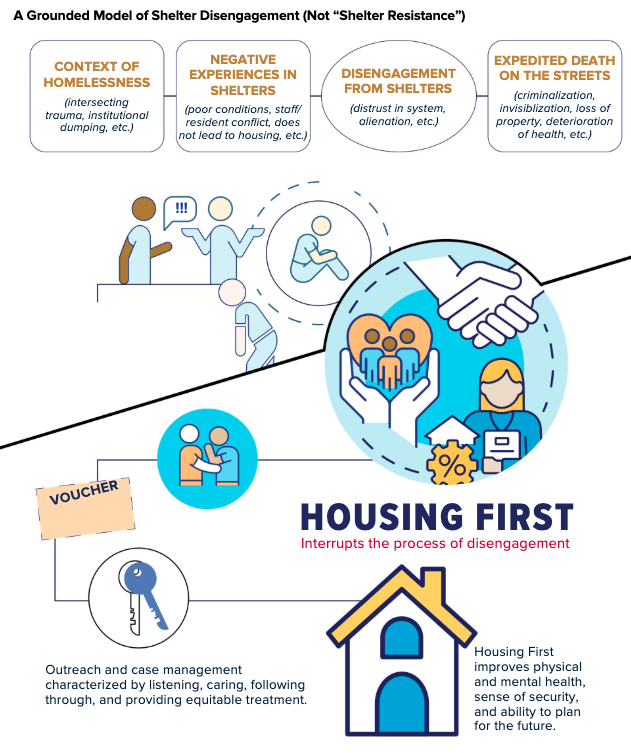
We find that those who were able to access the housing-first approach experienced this assistance as creating transformative pathways to housing that greatly improved their physical and mental health and ability to plan for the future. They attributed their successful moves into housing to the outreach workers who listened, cared, and followed through and who treated them equitably in a nondiscriminatory and nonjudgmental manner. Some highlighted the empathy, knowledge, and skills of outreach workers with lived experience of homelessness.
In contrast, our interviewees described shelters as characterized by poor sanitary conditions, frequent conflicts among residents and staff, and racial and ethnic bias; they also reported that, while in shelters, they received little help in securing more permanent housing. As a result, many did not see staying in shelters as beneficial to them. We argue that this is disengagement from a flawed shelter system, not “service resistance.” Yet, when they were living on the streets, criminalization measures forced them to make themselves invisible, complicating their access to assistance and producing negative consequences for their health.
Thus, we recommend more investment in and expansion of the housing-first approach and less investment in criminalization and coercion into shelters with poor conditions. Conditions in shelters need to be improved substantially for them to serve effectively as a short-term refuge before housing.